Climate-resilient food systems are essential for our future, and freeze-drying can materially cut food system emissions by eliminating most cold-chain needs and reducing weight and volume for transport, but the exact savings depend on product, energy mix, and process efficiency. It is best understood as one important tool among several for building a more climate-resilient, low-emission food system rather than a single silver bullet.
Cold chain emissions and food systems
Global agri‑food systems account for roughly 30–31% of human‑caused greenhouse gas emissions, with a growing share coming from post‑farm supply‑chain activities such as processing, transport, refrigeration, and retail. Recent FAO‑linked work estimates that food cold chains alone are responsible for about 4% of total global greenhouse gas emissions when both refrigeration energy and food losses due to inadequate cold chains are included.
In 2022, agrifood cold chains were estimated to emit about 1.32 gigatonnes of CO₂‑equivalent, with indirect emissions from electricity use more than double the direct emissions from refrigerants. National assessments show similar patterns; for example, food refrigeration is estimated to account for up to 4% of the United Kingdom’s total greenhouse gas emissions, with most of the impact arising during the use phase rather than manufacturing.
How freeze-drying changes logistics
Freeze-dried foods are shelf-stable at ambient temperatures because water is removed by sublimation under low pressure, which inhibits microbial growth and enzymatic spoilage. As a result, they generally do not require refrigerated storage or transport once processed, allowing them to bypass large parts of the cold chain and associated energy use.
Because freeze-drying removes most of the water, products become significantly lighter and more compact, which can reduce transport-related fuel use and emissions per unit of edible food moved. Some industry life‑cycle assessments report that, for certain products and assumptions, freeze‑dried options can have carbon footprints up to about 90% lower than frozen equivalents when cold‑chain logistics are fully accounted for, although these figures are context‑specific and not universal across all foods.
Climate resilience and reduced food waste
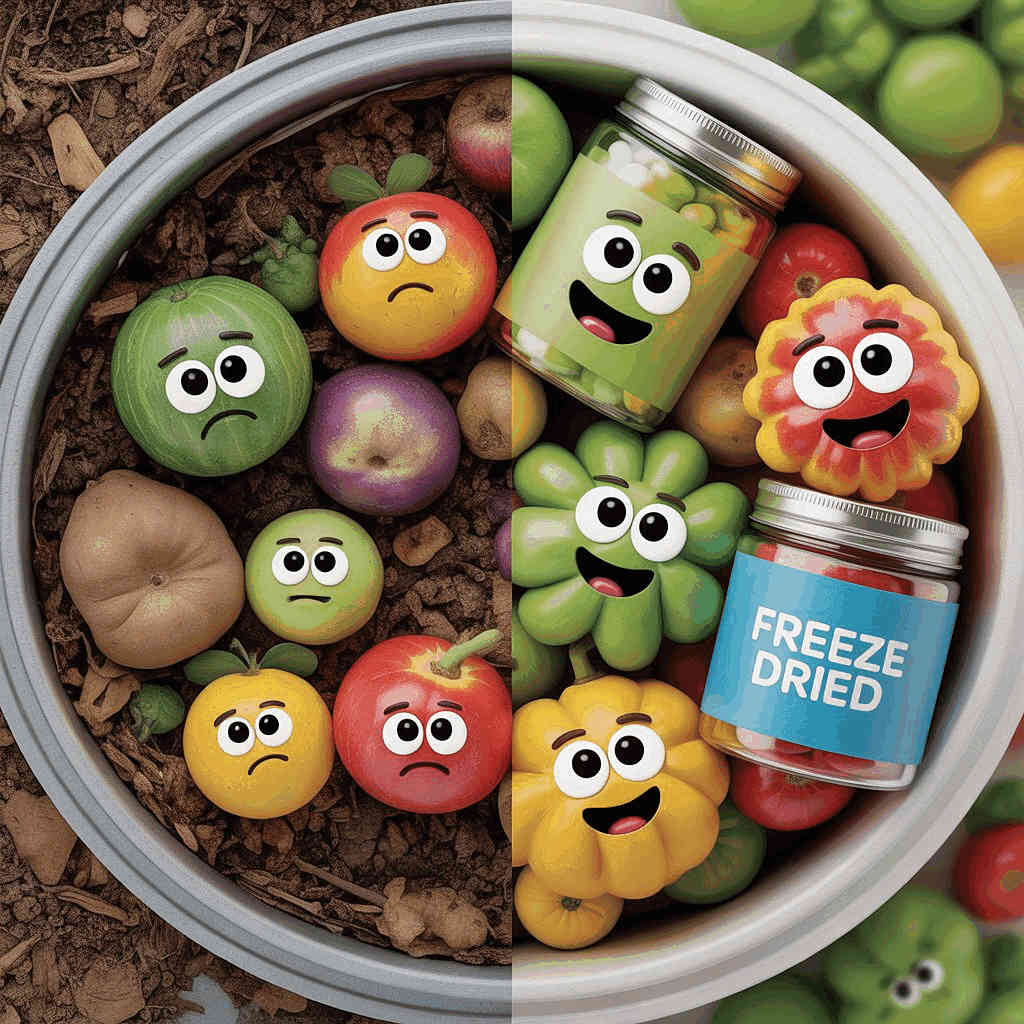
Freeze-drying can extend shelf life from months to many years, which helps buffer supply chains against climate‑driven disruptions such as extreme weather, transport delays, or power outages that compromise refrigerated or fresh foods. Longer shelf life also reduces food spoilage, and lowering food waste is a major mitigation lever because discarded food embodies upstream emissions from land use, inputs, and processing.
Climate change is expected to intensify heatwaves, humidity extremes, and other conditions that accelerate spoilage and complicate conventional preservation, increasing the value of robust, less temperature‑sensitive storage methods. Studies on food value chains and drought resilience emphasize that diversified preservation and storage strategies, including stable dry products, strengthen overall food system resilience to climate shocks.
Caveats, trade-offs, and limits
Freeze-drying is energy‑intensive at the processing stage, so climate benefits depend on using efficient equipment and low‑carbon electricity; otherwise, processing emissions can offset part of the savings from eliminating refrigeration. Policy and technology reviews on decarbonizing the food cold chain suggest that improving refrigeration efficiency, switching to low‑GWP refrigerants, and decarbonizing power grids remain essential alongside any shift toward more shelf‑stable products.
Not all foods are well suited to freeze-drying from a cost, texture, or cultural perspective, and over‑reliance on highly processed shelf‑stable foods raises nutrition and dietary quality questions that need parallel consideration. Experts therefore frame freeze‑drying as one component within a wider portfolio that includes cold‑chain decarbonization, reduced food waste, climate‑resilient agriculture, and dietary shifts to achieve substantial emission reductions across food systems.
sources
- FAO – “Greenhouse gas emissions from agrifood systems” (FAOSTAT brief)
https://openknowledge.fao.org/server/api/core/bitstreams/121cc613-3d0f-431c-b083-cc2031dd8826/content - UN News – “New FAO analysis reveals carbon footprint of agri‑food supply chain” https://news.un.org/en/story/2021/11/1105172
- UNEP & FAO – “Sustainable food cold chains: Opportunities, challenges and way forward” (technical brief / report) https://www.fao.org/3/cc0923en/cc0923en.pdf
- FAO News – “Amid food and climate crises, investing in sustainable food cold chains crucial”
https://www.fao.org/newsroom/detail/amid-food-and-climate-crises-investing-in-sustainable-food-cold-chains-crucial/en - UN News – “Sustainable food cold chains reduce waste, fight climate change: UN report”
https://news.un.org/en/story/2022/11/1130532 - International Institute of Refrigeration – “Meeting the challenge of a sustainable global food cold chain”
https://iifiir.org/en/news/meeting-the-challenge-of-a-sustainable-global-food-cold-chain - Global Food Cold Chain Council / UNEP – Cold chain methodology report
http://www.foodcoldchain.org/wp-content/uploads/2016/07/Reducing-GHG-Emissions-with-the-Food-Cold-Chain-NOV2015.pdf - MDPI (open‑access review) – “The Freeze‑Drying of Foods—The Characteristic of the Process”
https://pmc.ncbi.nlm.nih.gov/articles/PMC7603155/ - ScienceDirect – “Freeze-dried snacks obtained from frozen vegetable by-products…”
https://www.sciencedirect.com/science/article/abs/pii/S1466856422000340 - UNEP/FAO / One Planet School – “Sustainable Food Cold Chains” explainer https://oneplanetschool.wwf.it/pubblicazioni/unep-fao-sustainable-food-cold-chains-opportunities-challenges-and-way-forward
- Carbon Brief – “Food systems responsible for ‘one third’ of human‑caused emissions” https://www.carbonbrief.org/food-systems-responsible-for-one-third-of-human-caused-emissions/
- UN News – “Food systems account for over one‑third of global greenhouse gas emissions” https://news.un.org/en/story/2021/03/1086822
- FAO / UNEP / IIR news on agrifood cold‑chain emissions https://www.weforum.org/stories/2022/11/sustainable-food-cold-chains-feed-developing-countries/
- Industry LCA summary – “Sustainability in freeze drying: Preserving quality & the planet” https://www.freezedriers.com/blog/sustainability-in-freeze-drying-preserving-quality-the-planet/
- Industry explainer – “Sustainable Development in Freeze‑Dried Food Production: Eco‑Friendly Practices” https://mlb-biotrade.com/sustainable-development-in-freeze-dried-food-production-eco-friendly-practices/
- Pet‑food case analysis – “Freeze‑Dried vs. Kibble: Carbon Footprint Comparison”
https://www.loyalsaintspets.com/post/freeze-dried-vs-kibble-carbon-footprint-comparison - Tastybubu News and Learning Articles