Why freeze-drying does more than preserve
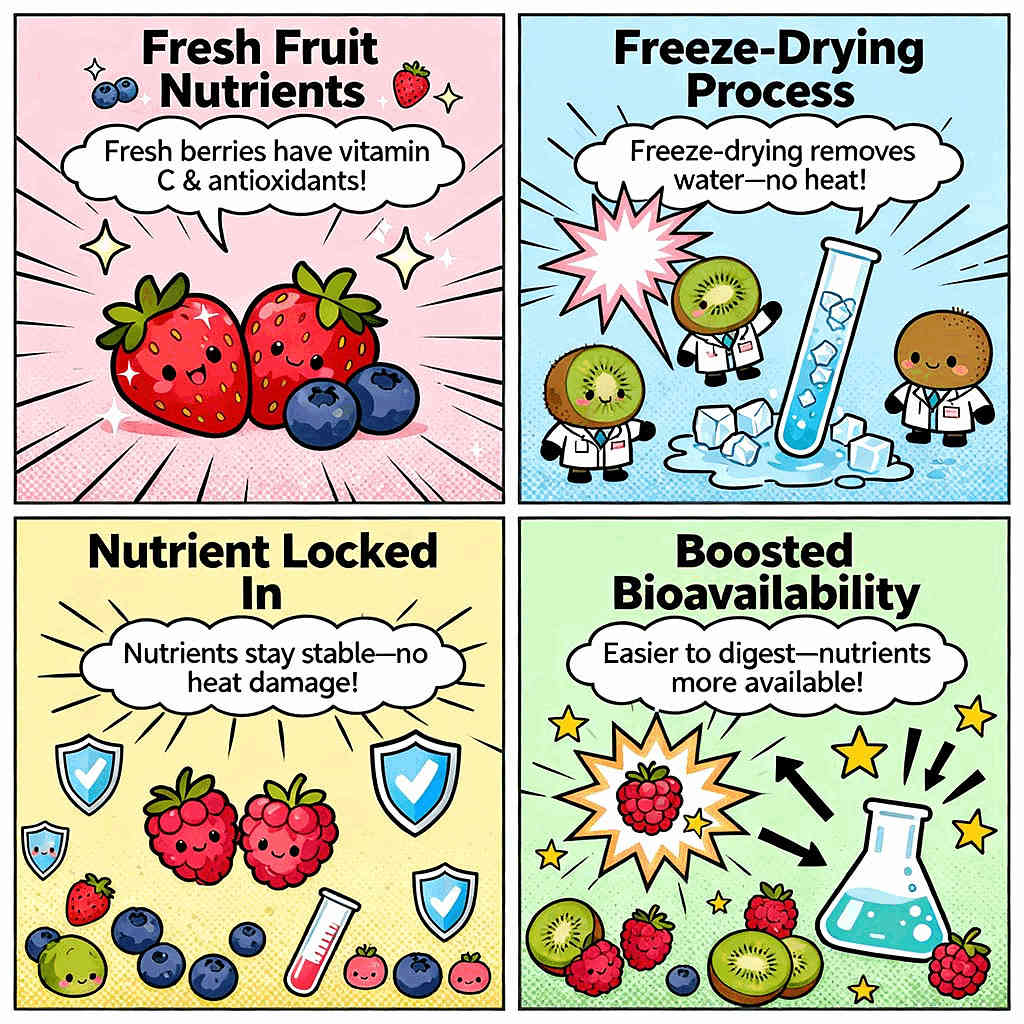
Bioavailability is a critical factor in nutrition science. Most people think of freeze-dried fruit as “just like fresh, but dry,” yet current research suggests something more interesting: freeze-drying can preserve, concentrate, and in some cases increase the bioaccessibility of key antioxidants and vitamins. Because water is removed at very low temperatures and pressure, delicate nutrients like vitamin C and flavonoids avoid the high-heat damage seen in oven or sun drying, while the porous structure created by sublimation can make these compounds easier to extract in digestion or in functional formulations.
Vitamin C: from fragile to fortified
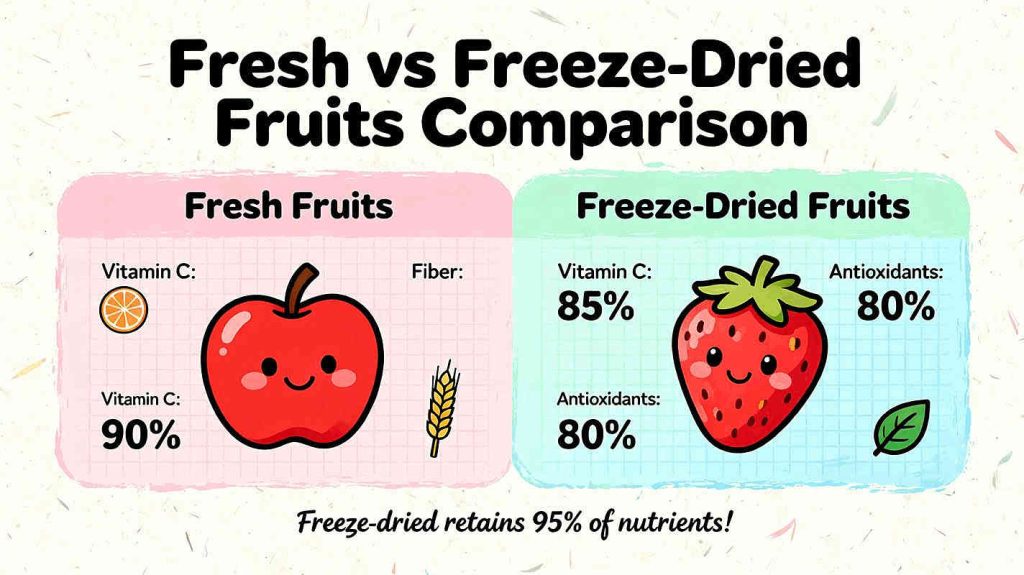
Several recent comparative studies show that freeze-drying consistently outperforms hot-air or sun drying for vitamin C retention in fruits such as guava, apricot, and mango peels, often cutting losses to single digits while thermal methods can destroy 50–70 percent. In some cases, like rosehip puree or mixed berry products, the measured vitamin C per 100 g of freeze-dried material is several times higher than in the original puree or fresh sample simply because the vitamin is concentrated as water is removed, creating a potent base for “natural vitamin C” snacks and supplements.
From a bioavailability angle, this matters because vitamin C is both highly reactive and water-soluble, so keeping it intact through processing and storage gives the body more to absorb when the product is consumed. For brands, being able to credibly state that a serving of freeze-dried fruit delivers vitamin C levels comparable to—or higher than—a typical serving of fresh fruit supports immunity, energy, and skin-health claims in a way other dried formats struggle to match.
Polyphenols and antioxidants: more extractable after freeze-drying
Beyond vitamins, polyphenols and flavonoids are a major reason parents look for “real fruit” snacks, because they support long-term metabolic and cardiovascular health. A 2025 study on litchi fruit and several earlier works on citrus and other fruits reported that freeze-drying increased total phenolics, flavonoids, and antioxidant activity compared with fresh or thermally dried samples, in part because the process releases low-molecular-weight phenolics that were previously bound to the cell wall.
Scoping reviews of fruits and vegetables echo this pattern: while freezing itself can degrade some phenolics, the combined effect of rapid freezing and subsequent freeze-drying tends to yield higher measurable antioxidant capacity than hot-air or sun-dried alternatives. In in-vitro digestion models, freeze-dried citrus co-products showed higher release of key flavonoids during intestinal stages, indicating better bioaccessibility for the gut to actually use, not just higher numbers on a lab report.
How processing choices shift nutrient outcomes
Not all freeze-dried products are created equal, and processing decisions—pre-treatments, freezing rate, shelf temperature, and chamber pressure—make a measurable difference. Reviews of freeze-drying conditions suggest that faster freezing, slightly higher drying temperatures (that shorten total drying time), and appropriately low pressures tend to preserve vitamin C and carotenoids better and maintain higher antioxidant activity.
Some fruits also respond well to gentle pre-processing: pulping, pureeing, or cutting can expose more surface area so that, after freeze-drying, antioxidant compounds are more accessible to digestive enzymes, while excessive blanching or long holding times before freezing can trigger early nutrient loss. For brands targeting kids or wellness-conscious adults, partnering with process engineers to fine-tune these parameters can turn a standard freeze-dried line into a genuine “functional” platform with verifiable nutrient advantages over both fresh-transported and conventionally dried competitors.
What this means for snacks and fortified products
For snack makers, the science supports positioning freeze-dried fruits and vegetables as more than just crunchy versions of fresh, especially when formulating powders for smoothies, gummies, or “hidden veg” kids’ snacks. High porosity and concentrated nutrients make it easier to deliver meaningful doses of vitamin C and polyphenols in small serving sizes, which is crucial when catering to picky eaters or busy adults who prefer convenient, shelf-stable options.
At the same time, the data are not universal: some matrices and compounds still degrade, and overly long or poorly controlled freeze-drying can reduce ascorbic acid and anthocyanins, so claims should be tied to specific ingredient and process data rather than generic “freeze-dried is always better” statements. The most credible story is “carefully freeze-dried and formulated to keep more of the good stuff bioavailable,” backed by internal testing or supplier certificates that align with what independent studies now show.
Sources
- Ma Y. et al. (2023) “Freeze-Drying of Fruits and Vegetables in Food Industry” https://www.tandfonline.com/doi/abs/10.1080/87559129.2022.2122992
- Rad S.B. et al. (2025) “Effect of drying methods on phenolic compounds and antioxidant activity” https://pmc.ncbi.nlm.nih.gov/articles/PMC11783714/
- García-Martínez E. et al. (2023) “In Vitro Bioaccessibility of Bioactive Compounds of Freeze-Dried Orange” https://pmc.ncbi.nlm.nih.gov/articles/PMC9862788/
- MLB Biotrade (2024) “Freeze-dried fruit: a treasure trove of vitamins” https://mlb-biotrade.com/freeze-dried-fruit-a-treasure-trove-of-vitamins-and-antioxidants/
- Bhatta S. et al. (2020) “Freeze-Drying of Plant-Based Foods” https://pmc.ncbi.nlm.nih.gov/articles/PMC7022747/
- Tastybubu News and Learning Articles