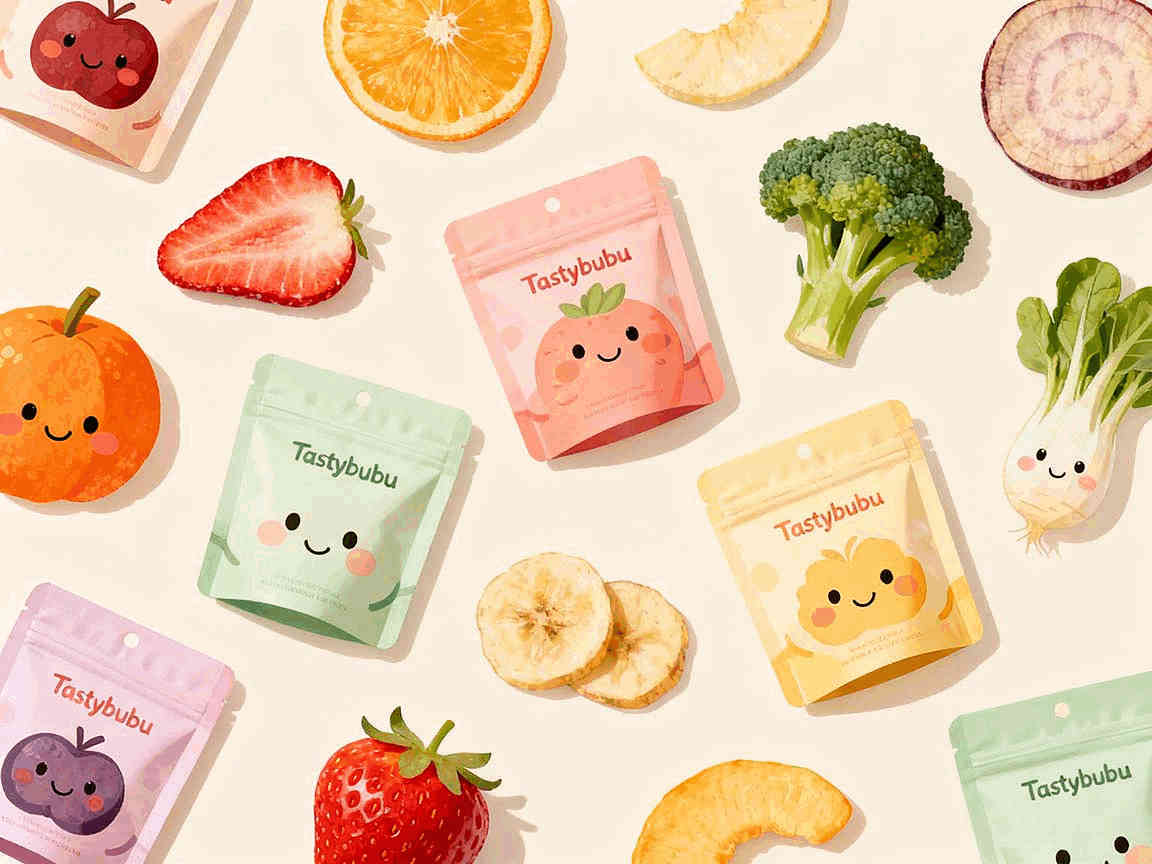

Snackable Science reveals that freeze-dried snacks can genuinely deliver concentrated nutrients and convenient formats for children, but the health impact depends heavily on portion size, added ingredients, and how clear and accurate the nutrition and fortification claims are on the label. Regulation around nutrient claims, fortified ingredients and marketing to infants and children is already quite strict in many jurisdictions, yet gaps remain where “better-for-you” snacks can look healthier than they are, especially when they are positioned as child-friendly or personalised.
Freeze-dried snacks
Freeze-drying removes almost all water while preserving most vitamins, minerals and phytochemicals, so a small portion of freeze-dried fruit can deliver nutrients equivalent to a much larger serving of fresh fruit. This concentration is a double-edged sword: it helps with picky eating and small appetites, but also makes it easy for children to consume more sugar and energy than parents realise if portions are not clearly guided.
Several recent characterisation studies on freeze-dried fruits (raspberries, strawberries, dates) show high retention of vitamin C, minerals and polyphenols, with moisture and water activity low enough for long shelf life, supporting their use as nutrient-dense snack bases and ingredients. Public health reviews on dried fruit also note that dried and freeze-dried formats can contribute positively to diet quality when they replace less healthy snacks, but warn that they should not crowd out fresh fruit or be treated as “unlimited” options for children.
Fortification and “precision” formats
Because freeze-dried powders are stable and easy to dose, they are increasingly used as carriers for extra micronutrients in biscuits, cereals and snack foods, effectively turning them into vehicles for “micro‑fortification.” Hospital and community dietetic guidance on food fortification for children already recommends adding concentrated ingredients to increase energy and micronutrient density, which aligns with what consumer brands are doing in a more convenient, shelf-stable form.
Emerging product-development research explores adding naturally mineral-rich freeze-dried powders (for example, bamboo shoot powder) to biscuits and other staples, demonstrating that specific, measured inclusions can significantly raise mineral content without major sensory downsides. These concepts translate readily into child-facing formats such as fortified cereal bites, smoothie powders, and purees, making it technically straightforward to design products that meet defined nutrient targets per portion.
Regulation, claims and labelling
In the UK and EU, any “source of” or “high in” vitamin or mineral claim on snacks must comply with harmonised nutrition and health claim rules, and fortified foods must follow specific compositional and labelling requirements. EU rules for “foods for specific groups” and for “food for infants and young children” set stricter standards for composition, contaminants and marketing than for general snacks, and they limit which added nutrients and novel ingredients can be used in products aimed at babies and toddlers.
Recent EU decisions on novel fortified ingredients also show how age-dependent restrictions are applied in practice: some folate and beta‑glucan ingredients, for example, must carry explicit statements that they are not suitable for infants or are only for consumers above certain ages, which has direct implications for any personalised or child-targeted fortified product. These frameworks help constrain the most aggressive fortification practices, but they do not directly regulate the broader “healthy convenience” narrative used in marketing, leaving room for parents to overestimate nutritional benefits if they rely more on front-of-pack messaging than on the mandatory nutrition table.
Safety, age-appropriateness and marketing to children
For babies and toddlers, regulators and paediatric nutrition services emphasise safety, appropriate textures, and balanced diets rather than isolated nutrient boosts, which is important for freeze-dried snacks that can be hard, crunchy, and low in moisture. Practical guidance for parents and health services on energy-dense diets and food fortification underscores that, even when using fortified foods, overall dietary patterns and supervised, age-appropriate feeding are the primary levers for improving growth and health.
sources
- Nutritional and Phytochemical Characterization of Freeze-Dried Raspberry Pomace https://pmc.ncbi.nlm.nih.gov/articles/PMC11011873/
- Evaluation of the Retention of Quality Characteristics in Fresh and Freeze-Dried Alpine Strawberries https://academic.oup.com/ijfst/article/43/5/865/7864518
- Evaluating the Nutritional, Physicochemical, and Quality Attributes of Freeze-Dried Barhi Date Products https://www.frontiersin.org/journals/sustainable-food-systems/articles/10.3389/fsufs.2025.1673255/full
- Dried fruit and public health – what does the evidence tell us? https://centaur.reading.ac.uk/84992/1/untitled.pdf
- Freeze-dried Bamboo Shoot Powder as a Natural Mineral Fortifier in Biscuits https://www.sciencedirect.com/science/article/pii/S2773139125000709
- Food Fortification (NHS and local dietetic leaflets) – Practical guidance on using fortified foods and ingredients to increase energy and nutrient intake in children and vulnerable groups. https://www.buckshealthcare.nhs.uk/wp-content/uploads/2021/05/PI_paeds_Energy-dense-diet-for-children.pdf and https://www.elft.nhs.uk/sites/default/files/2023-05/nutrition_and_dietetics_leaftlet_-_food_fortification_v1.pdf
- Nutrition Legislation Information Sheet (UK) https://www.gov.uk/government/publications/nutrition-legislation-information-sources/nutrition-legislation-information-sheet–2
- Food for Infants and Young Children (EU) https://food.ec.europa.eu/food-safety/labelling-and-nutrition/specific-groups/food-infants-and-young-children_en
- Foods for Infants and Other Groups (EFSA Topic Page) https://www.efsa.europa.eu/en/topics/topic/foods-infants-and-other-groups
- Labelling and Nutrition – Food Safety (European Commission) https://food.ec.europa.eu/food-safety/labelling-and-nutrition_en
- Lyophilized Fruits for Babies: Are They a Good Choice? https://onyyaorganic.com/lyopholized-fruits-for-babies-are-they-a-good-choice/
- Unpacking the Truth: Is Freeze-Dried Fruit a Choking Hazard for Little Ones? https://eherbal.co/unpacking-the-truth-is-freeze-dried-fruit-a-choking-hazard-for-little-ones/
- Tastybubu News and Learning Articles