Crop by-products from horticultural processing, such as peels, pomace, and trimmings—represent an untapped revenue stream for food manufacturers. Freeze-drying these agricultural crop remains (HCRs) is a credible route to both reduce food waste and generate high-value functional ingredients, but outcomes depend on the crop, process design, and market access. Evidence from recent reviews, case studies, and economic analyses supports your core claims about valorisation, nutrient concentration, and alignment with a circular, zero-waste bioeconomy.
Why crop by-products matter
Horticultural processing generates large volumes of side streams (pomace, peels, trimmings) that are often underused, landfilled, or sent to low-value uses such as animal feed, despite being rich in fibre and bioactive compounds. A 2025 review on transforming agri‑food waste estimates that about 30% of food produced for human consumption is lost during production and processing, and notes that these streams contain valuable organic compounds suitable for nutraceutical, food, and material applications.
An economic analysis of the circular bioeconomy in food and agriculture highlights that agricultural wastes are frequently burnt or landfilled, contributing to greenhouse gas emissions and local pollution instead of being recovered as value-added products. Circular-economy guidance from the UN Development Programme similarly calls for food by‑products to be “transformed and used at their highest value” as a key strategy to reduce food loss, emissions, and resource use.
Freeze-drying and nutrient/antioxidant retention
Freeze-drying removes water at low temperature and pressure, which generally helps retain the structure and many heat-sensitive compounds in plant materials compared with high‑temperature drying. A 2025 study on freeze-dried fruits and vegetables reported that freeze-dried products provided concentrated sources of phenolics and antioxidant capacity, with detailed profiling of health-promoting compounds across several species.
Comparative work on drying methods shows that higher-temperature air or oven drying can substantially reduce polyphenols and antioxidant activity in fruit by-products, while freeze-dried samples serve as a high-retention benchmark. For example, one study on grape pomace reported marked reductions in extractable polyphenols and antioxidant activity at 100–140 °C relative to a freeze-dried reference, underscoring the protective effect of low-temperature dehydration.
Turning residues into functional food powders
A review on the valorisation of vegetable wastes concludes that air drying and freeze-drying are both suitable for converting brassica residues (e.g., broccoli stems, cabbage outer leaves) into powdered ingredients, noting that the resulting powders are versatile, microbiologically stable, and rich in bioactive compounds for use as functional food components. In a process-development study within that work, brassica residues were successfully transformed into powders whose physicochemical and functional properties were characterised for potential applications in soups, infant foods, and meat or bakery products.
Specific product-focused research shows how freeze-dried by-product powders can be used in real foods: a 2022 study on apple pomace and pomegranate peel found that, after freeze-drying, these powders retained substantial phenolic content and antioxidant activity and could be incorporated into yogurt as functional ingredients, modifying composition while adding bioactive value. More broadly, research on freeze‑dried fruit powders notes their potential as concentrated sources of bioactives for nutraceutical and functional food formulations.
New revenue streams and circular-economy impacts
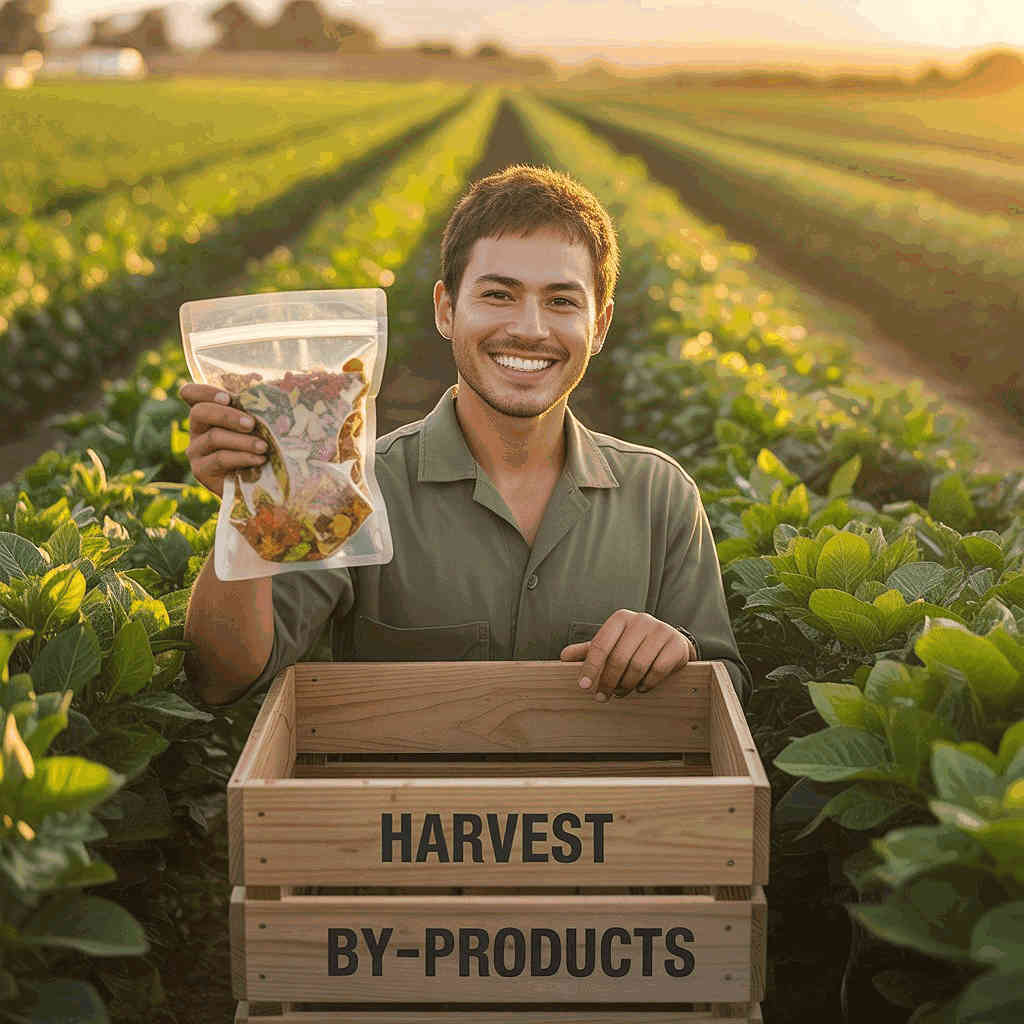
A recent UK report on horticultural crop waste identifies significant potential to convert residues such as peelings, pomace, and trimmings into high‑value chemicals and ingredients for food, pharmaceutical, and cosmetic industries, positioning this as a route to new revenue for growers and processors. Related coverage explains that by-products which would otherwise head to landfill or low-value outlets can feed into higher-value applications, supporting regional economic growth and reduced waste.
A New Zealand case study describes a technology platform developed to process surplus or off‑cut fruit and vegetables into shelf-stable powders, concentrates, and extracts, with the explicit goal of diverting waste from landfill while increasing returns for growers through premium export products. The authors note that, for some growers, upcycling unsold produce into ingredients can be the difference between profit and loss, and that it supports a “local, circular and sustainable bioprocessing food system.”
Climate and zero‑waste framing
A 2025 systematic review on transforming agri‑food waste frames valorisation (including extraction of bioactives and ingredient production) as a core pathway toward a zero-waste circular economy, arguing that conventional disposal methods like landfilling and incineration cause environmental damage and squander economic value. A 2024 analysis of the circular bioeconomy similarly emphasises that shifting from a linear “take‑make‑waste” model toward recovery and reuse of agricultural residues is critical for meeting climate and sustainability goals, since agricultural production and waste management together represent a substantial share of global emissions and resource use.
Complementing this, circular-economy guidance from UNDP lists transformation of food by‑products at their highest value as a key national-level lever to cut food loss and waste, reduce emissions, and strengthen food security. Global food-waste assessments estimate that roughly 30% of food goes to waste and that food waste contributes around 10% of global greenhouse gas emissions, underlining the mitigation benefit of diverting horticultural residues into value-added ingredients rather than landfill.
Sources
- Transforming agri‑food waste: Innovative pathways toward a zero‑waste circular economy https://pubmed.ncbi.nlm.nih.gov/40520695/
- An economic perspective of the circular bioeconomy in the food and agriculture sector. https://www.nature.com/articles/s43247-024-01663-6
- Impact of disruption and drying conditions on physicochemical and functional properties of Brassica residues . https://pmc.ncbi.nlm.nih.gov/articles/PMC9689784/
- Freeze-drying for the reduction of fruit and vegetable losses https://pmc.ncbi.nlm.nih.gov/articles/PMC11768221/
- Effect of drying temperature on the stability of polyphenols and antioxidant activity in grape pomace peels https://pubs.acs.org/doi/10.1021/jf960282f
- Effect of freeze-drying on apple pomace and pomegranate peel and their utilization in functional yogurt https://onlinelibrary.wiley.com/doi/10.1155/2022/3327401
- Freeze-drying of plant-based foods (review) https://pmc.ncbi.nlm.nih.gov/articles/PMC7022747/
- Horticultural crop waste extracts as functional ingredients for food products . https://www.sciencedirect.com/science/article/pii/S2772502225004858
- Minimizing food loss and utilizing agricultural waste https://www.sciencedirect.com/science/article/pii/S2352550923002087
- Development and biochemical characterization of freeze-dried fruit-based nutraceuticals https://ift.onlinelibrary.wiley.com/doi/10.1111/1750-3841.17537
- Report identifies new revenue streams from horticultural crop waste https://www.nri.org/latest/news/2025/report-identifies-new-revenue-streams-from-horticultural-crop-waste
- New Zealand tech turns surplus crops into high-value exports https://ecommercenews.co.nz/story/new-zealand-tech-turns-surplus-crops-into-high-value-exports
- 5 ways to reduce food loss and waste through a circular economy https://climatepromise.undp.org/news-and-stories/5-ways-reduce-food-loss-and-waste-through-circular-economy
- Food waste contributes 10% to global emissions (WRAP) https://www.wrap.ngo/media-centre/press-releases/food-waste-contributes-10-percent-global-emissions
- How post-harvest innovation strengthens global food security. https://www.innovationnewsnetwork.com/how-post-harvest-innovation-strengthens-global-food-security/64371/
- Tastybubu News and Learning Articles